10-23-08
We were all up and about shortly after 0600; with no breakfast available until 0900, we decided to depart Chopra, but not until
we made a hotel reservation in Varanasi. An earlier start would also ease the traffic situation. We’d gone about two km when one of the aggressive pedal rickshaws whacked RuthAnn’s saddle bag and sent her sprawling onto the street. She bounced right up with the damage to the bike being a bent right foot peg and a loose mirror. When Mukesh bent the peg back it broke off; soon a new one was mounted and off we went. We pushed hard to get out of the bad pot-holed roads and the state of Bihar which doesn’t seem to have a good stretch of road in it. Once we got to a road that had two lanes, sometimes even sporting a center line stripe, we made pretty good time. We arrived in Varanasi about1600 after covering 225 m. The Hotel Clark Varanasi is five star rated and we feel it is worth every penny we are spending.
1024-08
After sleeping in and taking a late breakfast, we are off to Sarnath to visit one the most important Buddhist sacred sites. It is here that Buddha preached his first major sermon to five followers in 528 BC and thus began one of the world’s great religions. The archaeological park contains many ruins from that time along with many more modern temples and monasteries.
10-25-08
We are in the hotel lobby at 0500 for a ride to the Ganges River to take a boat ride and to watch the sun come up over this polluted but holy river. One of our first sites is a human body floating near the shore, followed by bloated carcasses of a pig and a cow. We think we see the body of a child, but not sure if it real or not as we do see similar figures on shore that appear to be non-human. Many Hindus are bathing and washing clothes in the sewer-laden waters; we see the burning ghats and the newer electric crematorium. After ninety minutes of rowing up and down the river, we leave to the tape recorded warnings about pickpockets, touts, and other dangers that abound. Not only were we pestered by souvenir sellers on land, but also from boats on the river. The most original was two guys with a battery powered tv selling dvds of the river scenes. We decided that our memory was enough--dvd reminders are not necessary.
Saturday, October 25, 2008


Friday, October 24, 2008
Over the Mountain and Through the Woods
10-21-08
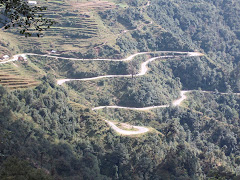
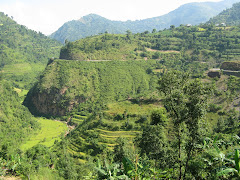
We got an earlier than usual start to try to avoid the traffic--it worked to a degree and we were soon heading west for about 30 km before taking a left and heading south on the Tribhuvan Highway. This was a one-lane paved road that twisted and turned through the mountains south of Kathmandu. We had some great views of the Himalayas with the road topping out at 2480 meters (8210’). Deep valleys with terraced hillsides presenting many shades of green made for wonderful scenery. The lack of traffic and pollution also added to the enjoyment of the ride and this day is was one of the best of the trip to date. It took us about eight hours to cover the 140 km to Hetauda and the Hotel Seema.
I finally got a handle on what kind of gas mileage we are getting with the bikes: a little over 74mpg!! Remember, though, that we are usually doing less than 60km/h and often times putting along at 30-40 km/h.
We all turned in early as the mountain riding had really worn us out. Little did we know what the 22nd had in mind for us……………….
We got an earlier than usual start to try to avoid the traffic--it worked to a degree and we were soon heading west for about 30 km before taking a left and heading south on the Tribhuvan Highway. This was a one-lane paved road that twisted and turned through the mountains south of Kathmandu. We had some great views of the Himalayas with the road topping out at 2480 meters (8210’). Deep valleys with terraced hillsides presenting many shades of green made for wonderful scenery. The lack of traffic and pollution also added to the enjoyment of the ride and this day is was one of the best of the trip to date. It took us about eight hours to cover the 140 km to Hetauda and the Hotel Seema.
I finally got a handle on what kind of gas mileage we are getting with the bikes: a little over 74mpg!! Remember, though, that we are usually doing less than 60km/h and often times putting along at 30-40 km/h.
We all turned in early as the mountain riding had really worn us out. Little did we know what the 22nd had in mind for us……………….
Kat-man-doo
10-19-08
A leisurely breakfast at KC’s restaurant was followed by quickly arranging a tour of the city and flights to see Everest.
The tour was money well spent as we had a guide and a driver and it felt good to let someone else fight with the traffic. On our 8 hours away from the hotel we saw Swayambhunath (aka The Monkey Temple because of the monkeys that abound there) a large Buddhist temple set on a steep hill overlooking the city, Bodhnath (Boudha) one of the world’s largest stupas (a bell-shaped Buddhist religious structure), Pashupatinath Nepal’s most important Hindu temple and the location of the burning ghats (cremations) on the Bagmati River, and Bhaktapur a step back in time to see a traditionally important small city.
The trip back to the hotel was slow with traffic being gridlocked most of the way. We saw several young women traffic police trying to make order out of the chaos--we did not envy them inhaling all those fumes and dust.
10-20-08
Away at 0600 for the airport and our flight to see Everest. Buddha Air was our host with a petite female first-officer who did all the flying. I gave her an A as she knew how to fly smoothly and not ruffle any feathers in the passenger compartment. After take-off we did a couple of climbing circles to gain altitude out of the Kathmandu Valley. The Himalayas were nice and clear and the flight attendant went up and down the aisle to each seat and told us what peaks we were looking at. We all took turns going forward to get a look out of the cockpit windows. I chatted a bit with the captain and discovered that he had done his flight training in Texas. The aircraft was a Beechcraft 1900D with nearly 20000 hours on the airframe; at one time these were a workhorse on the American commuter scene. We got a great view of Everest towering about 3000 feet above our aircraft.
In the afternoon, some of us took a leisurely stroll down to the Durbar Square chock-a-block full of temples and other historical structures. We also saw Freak Street (Jochne) where the “enlightened” foreigners hung out before Kathmandu grew to be the metropolis it is today.
A leisurely breakfast at KC’s restaurant was followed by quickly arranging a tour of the city and flights to see Everest.
The tour was money well spent as we had a guide and a driver and it felt good to let someone else fight with the traffic. On our 8 hours away from the hotel we saw Swayambhunath (aka The Monkey Temple because of the monkeys that abound there) a large Buddhist temple set on a steep hill overlooking the city, Bodhnath (Boudha) one of the world’s largest stupas (a bell-shaped Buddhist religious structure), Pashupatinath Nepal’s most important Hindu temple and the location of the burning ghats (cremations) on the Bagmati River, and Bhaktapur a step back in time to see a traditionally important small city.
The trip back to the hotel was slow with traffic being gridlocked most of the way. We saw several young women traffic police trying to make order out of the chaos--we did not envy them inhaling all those fumes and dust.
10-20-08
Away at 0600 for the airport and our flight to see Everest. Buddha Air was our host with a petite female first-officer who did all the flying. I gave her an A as she knew how to fly smoothly and not ruffle any feathers in the passenger compartment. After take-off we did a couple of climbing circles to gain altitude out of the Kathmandu Valley. The Himalayas were nice and clear and the flight attendant went up and down the aisle to each seat and told us what peaks we were looking at. We all took turns going forward to get a look out of the cockpit windows. I chatted a bit with the captain and discovered that he had done his flight training in Texas. The aircraft was a Beechcraft 1900D with nearly 20000 hours on the airframe; at one time these were a workhorse on the American commuter scene. We got a great view of Everest towering about 3000 feet above our aircraft.
In the afternoon, some of us took a leisurely stroll down to the Durbar Square chock-a-block full of temples and other historical structures. We also saw Freak Street (Jochne) where the “enlightened” foreigners hung out before Kathmandu grew to be the metropolis it is today.
Flora and Roads
For those who are wondering what we look at along the road--when there is time--flowers and greenery are everywhere. Cana lilies grow in the compounds of the poorest, red and yellow are most common, occasionally salmon, and, less often, a yellow with a delicate salmon stripe. Pothos grows in pots all over and is used to decorate the table in "finer" restaurants. Marigolds are everywhere--in huge clumps in-ground and in patio pots; these are the flower of choice to decorate shrines and, strung into chains, to deck out wedding cars. Bougainvilla--the bright pink--grows in gardens and in some parks. Dahlias, hibiscus, geraniums--usually the orange/red color, zinnias and dianthus complete most garden scapes. What surprised me were the mums we saw growing in Tansen, Pokhara, and Kathmandu--perhaps because it is cooler there. There are many flowering bushes unmknown to me--but they are very beautiful. Banana trees and palm trees add their "greenness" to the picture. All of this competes with the dust and piles of garbage throughout the landscape.
Now for the roads--you probably have a good idea from Jean's and Steve's description
earlier on the blog--but I feel compelled to add my two bits. Potholes and dust slow
us way down, especially when we try to pass a vehicle going 15 klicks per hour and realize that we are headed for a pothole the size of the Grand Canyon or that a bus
with Mr. Tata's name is competing for the same pothole. We give way and regain our spot behind the diesel-fume-spewing-very-slow-moving vehicle, and are happy to be there, until the jockeying begins again. Most of the trucks and buses are colorfully decorated with signs painted on the front bumper proclaiming Slow Drive--Long Life
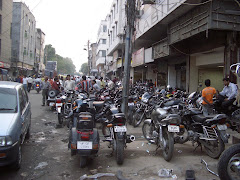
(Ross is convinced that that is not necessarily true here). Others claim to be Road King or Speed Control--40 kms per hour--which is way too fast. Bicycle rickshaws are small competition, but one plowed into my saddle bag yesterday and I went down. Fortunately I didn't see him coming (he came from the back) and so I was very relaxed and didn't hurt myself--and Mechanic Mukesh made short work of the repairs--a new headlight and rebending the foot peg. To get a real idea of the traffic, imagine any two-lane road that has bicycles, bicycle rickshaws, scooters, motorcycles, some cars--mainly taxis--vans--mainly used as small buses--big buses, big trucks, a few oxen, cows, goats, and dogs as well as people trying to walk in the street or across the street and you have a great picture of driving here. by ra
Now for the roads--you probably have a good idea from Jean's and Steve's description
earlier on the blog--but I feel compelled to add my two bits. Potholes and dust slow
us way down, especially when we try to pass a vehicle going 15 klicks per hour and realize that we are headed for a pothole the size of the Grand Canyon or that a bus
with Mr. Tata's name is competing for the same pothole. We give way and regain our spot behind the diesel-fume-spewing-very-slow-moving vehicle, and are happy to be there, until the jockeying begins again. Most of the trucks and buses are colorfully decorated with signs painted on the front bumper proclaiming Slow Drive--Long Life
(Ross is convinced that that is not necessarily true here). Others claim to be Road King or Speed Control--40 kms per hour--which is way too fast. Bicycle rickshaws are small competition, but one plowed into my saddle bag yesterday and I went down. Fortunately I didn't see him coming (he came from the back) and so I was very relaxed and didn't hurt myself--and Mechanic Mukesh made short work of the repairs--a new headlight and rebending the foot peg. To get a real idea of the traffic, imagine any two-lane road that has bicycles, bicycle rickshaws, scooters, motorcycles, some cars--mainly taxis--vans--mainly used as small buses--big buses, big trucks, a few oxen, cows, goats, and dogs as well as people trying to walk in the street or across the street and you have a great picture of driving here. by ra
Thursday, October 23, 2008
A High Point
Kathmandu! The name conjures up images of mountains, climbers, and Sherpa guides so I wasn't prepared for this bustling metropolis of over a million people. As we fought our way into the city through the usual frenetic traffic, we passed huge, golden Buddhas, temples and high-rise modern buildings. Our hotel is in a tourist district full of schlock shops, outfitters and tour operators offering trekking, rafting, bus and city tours. Like Pokhora, there are tons of tourists, mainly young Europeans, all looking lean and fit so we blend right in with the crowd :-)
There was lots to do here so we booked a city tour for $20 each which lasted six hours and took in the Buddhist Monkey Temple, a Hindu shrine, and the walled city of Bhakapur dating from the twelfth century.
The Buddhist temples are huge domes that contain some relic of Buddha such as bone, hair or fingernail. They are sealed but on each compass point, there is an alcove containing a statue of Buddha where people go to pray. Incense fills the air and as does the sound of people ringing a bell to announce their arrival to the deity. Prayer wheels of all sizes line the perimeter and people walk along the row gently making them turn which sends the mantra carved on the wheel up to wherever. Above it all, multicoloured prayer flags fly in the breeze overhead like some used car lot also carrying their message on the wind.
Bhakapur was a huge walled city containing a royal palace and numerous temples including the highest one in Nepal. People still occupy the buildings and the narrow streets are filled with the daily life of shopping, gossiping and children playing. We are always amused at how the kids here make games and play with nothing more then stones or each other. Swings are popular but there isn't a Play Station in sight.
The most interesting but disturbing stop was at the Hindu shrine. Apparently, this one has the same importance to Hindus as Mecca has to Muslims. We were unable to enter certain areas but did catch a glimpse of a giant, brass bull that is revered as Shiva's ride. Then it was down to the ghats, steps leading down to a river, where we witnessed a cremation taking place. The body was wrapped in a shroud and placed on a stack of wood which was then set on fire using small kindling and gee. The males of the family sit behind a grate and watch while a worker completes this unsettling task. In the short time we were there, there were four cremations taking place. When they're complete, the ashes are swept into the river where children were merrily swimming and fishing! To break the somber mood, Bill said "Imagine when that guy goes home at night and his wife says 'Do you want to barbecue'?"
I had imagined that we would be able to see Mount Everest at 29,028 ft, from Kathmandu but it was not to be so we took a plane ride to within 5 nautical miles of the face and it was truly spectacular! Everest, known in Nepal as Sagarmatha, Goddess of the Sky and in Tibet as Jomolungma, Mother of the World, was named for an English surveyor in 1865. It wasn't until May 29, 1953 that Sir Edmund Hilliary, a Kiwi, and his Sherpa guide, Tenzing, were the recorded people to reach the summit. For a fascinating account of a doomed climb, get Into Thin Air by Jon Kakauer.
Road to Darjeeling is washed out and bridge to Sikkim is gone so tomorrow we head south, back to India.
There was lots to do here so we booked a city tour for $20 each which lasted six hours and took in the Buddhist Monkey Temple, a Hindu shrine, and the walled city of Bhakapur dating from the twelfth century.
The Buddhist temples are huge domes that contain some relic of Buddha such as bone, hair or fingernail. They are sealed but on each compass point, there is an alcove containing a statue of Buddha where people go to pray. Incense fills the air and as does the sound of people ringing a bell to announce their arrival to the deity. Prayer wheels of all sizes line the perimeter and people walk along the row gently making them turn which sends the mantra carved on the wheel up to wherever. Above it all, multicoloured prayer flags fly in the breeze overhead like some used car lot also carrying their message on the wind.
Bhakapur was a huge walled city containing a royal palace and numerous temples including the highest one in Nepal. People still occupy the buildings and the narrow streets are filled with the daily life of shopping, gossiping and children playing. We are always amused at how the kids here make games and play with nothing more then stones or each other. Swings are popular but there isn't a Play Station in sight.
The most interesting but disturbing stop was at the Hindu shrine. Apparently, this one has the same importance to Hindus as Mecca has to Muslims. We were unable to enter certain areas but did catch a glimpse of a giant, brass bull that is revered as Shiva's ride. Then it was down to the ghats, steps leading down to a river, where we witnessed a cremation taking place. The body was wrapped in a shroud and placed on a stack of wood which was then set on fire using small kindling and gee. The males of the family sit behind a grate and watch while a worker completes this unsettling task. In the short time we were there, there were four cremations taking place. When they're complete, the ashes are swept into the river where children were merrily swimming and fishing! To break the somber mood, Bill said "Imagine when that guy goes home at night and his wife says 'Do you want to barbecue'?"
I had imagined that we would be able to see Mount Everest at 29,028 ft, from Kathmandu but it was not to be so we took a plane ride to within 5 nautical miles of the face and it was truly spectacular! Everest, known in Nepal as Sagarmatha, Goddess of the Sky and in Tibet as Jomolungma, Mother of the World, was named for an English surveyor in 1865. It wasn't until May 29, 1953 that Sir Edmund Hilliary, a Kiwi, and his Sherpa guide, Tenzing, were the recorded people to reach the summit. For a fascinating account of a doomed climb, get Into Thin Air by Jon Kakauer.
Road to Darjeeling is washed out and bridge to Sikkim is gone so tomorrow we head south, back to India.
Monday, October 20, 2008
Tansen-Pokhara-Gorkha-Kathmandu
10-15-08
Dawn in Tansen, RA and I got up with the sun to see the mountains this morning and they again obliged. Fog in the valley, a full moon setting and snow white peaks illuminated by the rising sun added another memory to this adventure. The do-it-all host at the hotel offered us masala tea which was a nice lead in to the typical breakfast of omelette and buttered toast with jam. He also brought RA some banana fritters which were shared amongst our fellow riders.
It was a great day for riding and the 135 km to Pokhara melted away. Deep, lush valleys with terraced rice fields, tumbling, milky, glacier-fed rivers made for great scenery. The road was dusty at times from all the dirt left over from landslides and soil washed on to the road from th monsoons. Rest stops often entail cleaning the dust from our eye-glasses and face shields along with the ever present glass bottle of Coca-Cola to wash the dust and diesel fumes from our throats. Coke is everywhere. At most rest stops there is a small mud/brick store selling soda and snacks. There is usually a small Coke labeled fridge (about the size of large picnic cooler) with soda and other things keeping cool inside. At one stop several bright yellow chicken feet shared space with the soda bottles.
10-16-08
Pokhara. A settlement by a lake, Fewa Tal, back-dropped by the Annapurna Range of the Himalayas. A tourist mecca full of trekking shops, internet cafes, and western style restaurants.
We had a nice breakfast on the rooftop restaurant of the Snowland Hotel before being informed that we had to vacate our rooms and move to another hotel down the street due to the early arrival of a group of trekkers who had to return to town because of illness.
We spent about two hours at the recently opened Gurkha Museum tracing the history of these great fighting men. Two of the docents were retired Gurkhas--very humble and charming men.
The mountain peaks are visible from almost any point in town,, but you can only see the tops. A trip to Sarangkot was needed to see more of the mountains so we arranged a car to take us to a viewpoint early the next day.
10-17-08
The wake-up knock came at 0430 and we were away in the dark at 0500 for Sarangkot which is about 2000 feet higher in elevation than Pokhara. We arrived at the viewing area before sunrise and were joined by 40-50 others. When the sun finally showed itself on the horizon it brought a stir from the crowd and soon the snow on the peaks began to glow white. A very impressive sight!
We still had to a little riding and 118 km later we were in Gorkha, a small mountain town. At our first rest stop some of us climbed up steep steps to a small temple. Jean and I went into the small temple separately and received a blessing from the holy man there. We each received our red forehead dot (a paste-like stuff with a few grains of rice in it) and a piece of fruit; Jean got a banana and I got an apple.
We had a bit of trouble finding a hotel and ended up in a “clean” but spartan hotel that cost us a total of 500 Nepali rupees ($6.33)! We hiked up the hill to eat dinner at our original hotel of choice. This place is cheap; RA and I each had a huge plate of chop-suey, a beer and a soda for another 500 rupees.
10-18-08
The Prithvi Highway along the river Trish Nuli leads us to Kathmandu. The first part of the 150 kilometer journey takes us through high green mountains and along a deep gorge with many suspension bridges and small cable cars that the Nepalis use to cross the river. We thought the road would get better as we neared the biggest city in Nepal, but we were wrong. The road actually deteriorated and we were often chugging along in first gear at 20 km/h eating the diesel fumes of the slow moving trucks and buses. Our first hotel choice, the Kathmandu Guest House was fully booked, so we ended up a few short blocks away at the Excelsior Hotel; a mid-range hotel that costs $45/night. We are in the Thamel area of the city described as a tourist ghetto in the guide book. Lots of hotels, internet cafes, restaurants, and shops catering to every need of the foreign tourist. That’s ok with us as we feel like being a bit pampered. We have just returned from an excellent Italian dinner and are busy washing clothes and watching the BBC channel on the tv. We will probably be here for three nights--we are thinking of taking a flight over Mount Everest and some of the other Himalayan peaks. Tomorrow we will keep out feet firmly on the ground visiting some of the sights in this bustling and crowded city.
Dawn in Tansen, RA and I got up with the sun to see the mountains this morning and they again obliged. Fog in the valley, a full moon setting and snow white peaks illuminated by the rising sun added another memory to this adventure. The do-it-all host at the hotel offered us masala tea which was a nice lead in to the typical breakfast of omelette and buttered toast with jam. He also brought RA some banana fritters which were shared amongst our fellow riders.
It was a great day for riding and the 135 km to Pokhara melted away. Deep, lush valleys with terraced rice fields, tumbling, milky, glacier-fed rivers made for great scenery. The road was dusty at times from all the dirt left over from landslides and soil washed on to the road from th monsoons. Rest stops often entail cleaning the dust from our eye-glasses and face shields along with the ever present glass bottle of Coca-Cola to wash the dust and diesel fumes from our throats. Coke is everywhere. At most rest stops there is a small mud/brick store selling soda and snacks. There is usually a small Coke labeled fridge (about the size of large picnic cooler) with soda and other things keeping cool inside. At one stop several bright yellow chicken feet shared space with the soda bottles.
10-16-08
Pokhara. A settlement by a lake, Fewa Tal, back-dropped by the Annapurna Range of the Himalayas. A tourist mecca full of trekking shops, internet cafes, and western style restaurants.
We had a nice breakfast on the rooftop restaurant of the Snowland Hotel before being informed that we had to vacate our rooms and move to another hotel down the street due to the early arrival of a group of trekkers who had to return to town because of illness.
We spent about two hours at the recently opened Gurkha Museum tracing the history of these great fighting men. Two of the docents were retired Gurkhas--very humble and charming men.
The mountain peaks are visible from almost any point in town,, but you can only see the tops. A trip to Sarangkot was needed to see more of the mountains so we arranged a car to take us to a viewpoint early the next day.
10-17-08
The wake-up knock came at 0430 and we were away in the dark at 0500 for Sarangkot which is about 2000 feet higher in elevation than Pokhara. We arrived at the viewing area before sunrise and were joined by 40-50 others. When the sun finally showed itself on the horizon it brought a stir from the crowd and soon the snow on the peaks began to glow white. A very impressive sight!
We still had to a little riding and 118 km later we were in Gorkha, a small mountain town. At our first rest stop some of us climbed up steep steps to a small temple. Jean and I went into the small temple separately and received a blessing from the holy man there. We each received our red forehead dot (a paste-like stuff with a few grains of rice in it) and a piece of fruit; Jean got a banana and I got an apple.
We had a bit of trouble finding a hotel and ended up in a “clean” but spartan hotel that cost us a total of 500 Nepali rupees ($6.33)! We hiked up the hill to eat dinner at our original hotel of choice. This place is cheap; RA and I each had a huge plate of chop-suey, a beer and a soda for another 500 rupees.
10-18-08
The Prithvi Highway along the river Trish Nuli leads us to Kathmandu. The first part of the 150 kilometer journey takes us through high green mountains and along a deep gorge with many suspension bridges and small cable cars that the Nepalis use to cross the river. We thought the road would get better as we neared the biggest city in Nepal, but we were wrong. The road actually deteriorated and we were often chugging along in first gear at 20 km/h eating the diesel fumes of the slow moving trucks and buses. Our first hotel choice, the Kathmandu Guest House was fully booked, so we ended up a few short blocks away at the Excelsior Hotel; a mid-range hotel that costs $45/night. We are in the Thamel area of the city described as a tourist ghetto in the guide book. Lots of hotels, internet cafes, restaurants, and shops catering to every need of the foreign tourist. That’s ok with us as we feel like being a bit pampered. We have just returned from an excellent Italian dinner and are busy washing clothes and watching the BBC channel on the tv. We will probably be here for three nights--we are thinking of taking a flight over Mount Everest and some of the other Himalayan peaks. Tomorrow we will keep out feet firmly on the ground visiting some of the sights in this bustling and crowded city.
FWIW
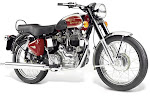
Our bikes are Royal Enfield Bullet Machismo 500s; the phones we bought in Delhi are LG Bullet 285s.
Fuel in Nepal (probably mid-80s octane) costs about US$5.04 (100 NR/liter)
The fuel pumps here do not show the total cost of fuel dispensed, only the volume.
At our last gas stop, a Nepali lad about 10 years old asked me where I was from. When I told him America, he said he was from the USA too. He has lived in Baltimore, MD, for about 18 months and is back in Nepal for three months. His father is working in the US as a civil engineer.
One of the obstacles we have to avoid each day are piles of stuff along the road that spill out on to the road surface. Sand, gravel, stones, hay, etc. Other vehicles have usually flattened the edge of the pile so if you get a little close it is not too traumatic.
One day Ross and I ended up with different key fobs than we had the day before, so at a rest stop we exchanged keys. Despite different numbers on the keys, both worked in either bike.
Signal lights are not used a lot here, but some busses and trucks will turn on the right signal light to tell you that is ok to pass. One still must verify the clear path before overtaking and that the vehicle you are passing is not turning right! The trucks in Mexico do the same thing with the left signal light and the same precautions apply.
Beer choices for the past few days are: Everest, San Miguel, Tuborg, and Carlsberg. The beer comes in 650ml bottles so a healthy dose of drink.
Virtually 100% of the bikes here have substantial crash bars. There is usually a small extension on the outside top bar that allows the rider to hang things from the crash bars. Things seen hanging from the crash bars: plastic bags stuffed with who knows what, a briefcase, a motorcycle helmet, a large fish, a kid’s school backpack.
Fuel in Nepal (probably mid-80s octane) costs about US$5.04 (100 NR/liter)
The fuel pumps here do not show the total cost of fuel dispensed, only the volume.
At our last gas stop, a Nepali lad about 10 years old asked me where I was from. When I told him America, he said he was from the USA too. He has lived in Baltimore, MD, for about 18 months and is back in Nepal for three months. His father is working in the US as a civil engineer.
One of the obstacles we have to avoid each day are piles of stuff along the road that spill out on to the road surface. Sand, gravel, stones, hay, etc. Other vehicles have usually flattened the edge of the pile so if you get a little close it is not too traumatic.
One day Ross and I ended up with different key fobs than we had the day before, so at a rest stop we exchanged keys. Despite different numbers on the keys, both worked in either bike.
Signal lights are not used a lot here, but some busses and trucks will turn on the right signal light to tell you that is ok to pass. One still must verify the clear path before overtaking and that the vehicle you are passing is not turning right! The trucks in Mexico do the same thing with the left signal light and the same precautions apply.
Beer choices for the past few days are: Everest, San Miguel, Tuborg, and Carlsberg. The beer comes in 650ml bottles so a healthy dose of drink.
Virtually 100% of the bikes here have substantial crash bars. There is usually a small extension on the outside top bar that allows the rider to hang things from the crash bars. Things seen hanging from the crash bars: plastic bags stuffed with who knows what, a briefcase, a motorcycle helmet, a large fish, a kid’s school backpack.
Subscribe to:
Comments (Atom)